
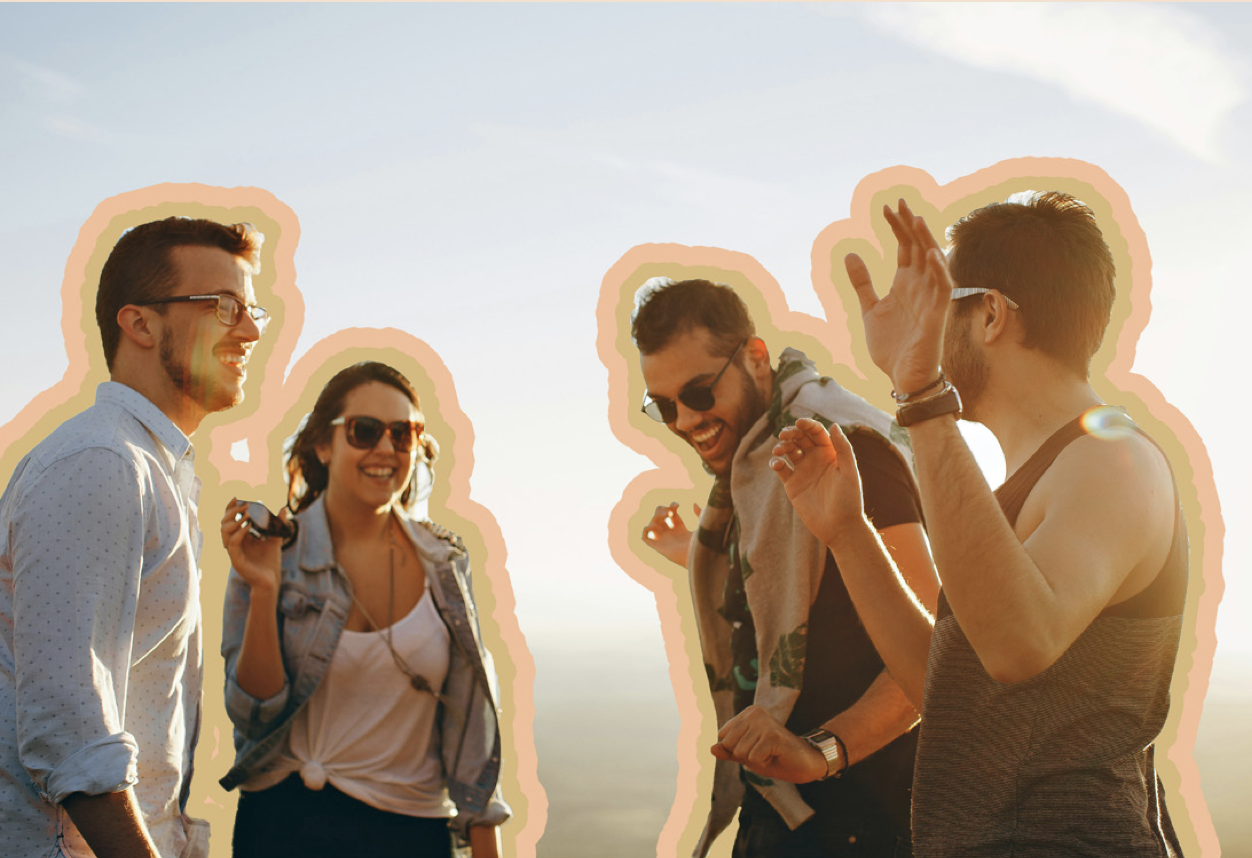
By now, we’ve all heard the proverb, “it takes a village to raise a child.” Not only that, but most of us have grown up surrounded by a village we call friends and family. Yet, as I have grown older, that phrase has taken on a new meaning. That village used to just mean my family. My parents, of course, but also my grandparents, my aunts, my uncles, a few cousins, and some extended family. When I grew up, I realized that my village could be people I chose to be in my life.
Originally, that village was an afterthought. I knew I had friends and family that would be there no matter what, but I took them for granted in so many ways. I needed to be there for them the same way they were there for me. My village became something I wanted to pour my soul into. The people who were there to support me in my worst of times were also there to celebrate my biggest accomplishments.
As I grew in these relationships, I realized that people wanted a village without contributing anything to it. They want the village without being a villager.
The Loneliness Epidemic
I cannot just sit here and say this is a generational or societal problem. I think it goes deeper than that. This is a problem that overlaps in many areas of our lives, especially as Gen Z. We grew up as the first generation to experience social media and have the internet at our fingertips. We survived a pandemic. We’re in a time of unparalleled political turmoil.
We are the loneliest generation to date, according to Abby Bowler, a writer for Ballard Brief at BYU. Our futures are uncertain, and our pasts feel like they’ve been written for us. A statement from the U.S. Department of Health and Human Services reads, “Social connection is a fundamental human need, as essential to survival as food, water, and shelter.”
The paper goes on to explain that our ability to rely on each other is crucial to our survival and has been throughout history. This is not a new concept, but it has evolved in areas that we are not familiar with.
Our interactions turned from childhood daycares and playgrounds to screen time. Our information went from newspapers being handed out on our doorsteps to social media headlines. Our fun went from board games to video games in a matter of months. Bowler continues in the article by stating, we have the power of the world at our fingertips, yet we are the most isolated we’ve ever been.
And, it’s causing problems.
Gen Z reports feeling lonelier than older generations. Their feelings stem from fewer face-to-face interactions and more online scrutiny. Our village became less of a tangible space we go to and more of an online chatroom we visit when we’re bored.
The Death of Third Spaces
When I was younger, I remember meeting people everywhere I went. Aside from stranger danger, I used to meet friends at the park, daycare or even at malls with supervision from my parents. I had different friend groups: friends I went to the mall with and friends that I only saw at the park in my neighborhood. I met them while I was outside of my house in spaces meant for socializing.
Every integral part of human interaction is now shared through a screen. That village that once took a lifetime to accumulate is now ready at our fingertips. Yet, it’s harder to keep that village from falling apart.
We’ve grown up like this. As soon as we were hitting our strides into adulthood, a global pandemic hit, eliminating the need for third spaces. We couldn’t just make weekend plans anymore; we had to schedule Zoom dates and coordinate social distancing. But that’s mostly dead now. Libraries are defunded. Parks are turning into department stores. Malls are closing at alarming rates, and online shopping is in. The foundation of human connection is slowly crumbling under our feet.
As a result, we no longer prioritize the relationships we form outside of school, work, and sometimes even family. We mobile order our coffees instead of interacting with the baristas. We walk with music blasting through our headphones instead of stopping to talk with our neighbors. We click “add to cart” instead of trying on prom dresses with our friends. We like, share, and comment on others’ social media posts, although we’re nowhere to be seen on their page.
We got used to creating connections through our screens. The village we spent so long building was tucked in a little box of apps. Easy to message, but hard to make plans for. So, what happens when we don’t crave the face-to-face interactions we were once desperately needing? We pivot.
Social priority
When those third spaces are taken away from us, we prioritize what we need in terms of social interactions. We convince ourselves that school and work are enough to keep us completely satiated.
There are three components of social connection according to the U.S. Department of Health and Human Services: structure, function, and quality. The components rely on how we position our lives. Whether we make friends at work or in a workout class. Whether we call friends in crisis or elation. Whether we actually like our relationships or are only pursuing them out of obligation.
In the United States, historically, the older we get, the less socially connected we become. It’s not because we know fewer people or are not meeting them. It’s because other priorities take shape in our lives.
Work becomes overwhelming. Meeting deadlines, networking constantly, and commuting take over social responsibility. Wellness and hobbies become something we need to be well-rounded people in adulthood. They feed their way into any free time we have.
We are constantly being bombarded at every angle with new ways to make friends, find relationships, and build connections outside of our work obligations. We see it on every social platform we’re on. Yet, when the pressure of life is eating us up inside, there’s nowhere to go for support. Our villages are locked in passwords and social accounts that do not mirror real life.
When we finally slow down and realize that we need social interaction beyond our obligations, friendships become scarce. The villages we grew up with no longer need us because we don’t need them. We spend so long prioritizing other things in our life that sustaining friendships was left on the back burner.
Being The Villager
Now, I have heard a time or two that we don’t need anybody. That friendships are transactions and we can live without them.
This notion was especially prevalent in the new trend to “protect one’s peace,” a trend centered around protecting our mental health by cutting off those who don’t have the best intentions for us. Although good on paper, this trend became a leading topic of discussion for many in our generation.
I first noticed this state of mind when I was graduating high school. We were three years out of the pandemic; I was excited to start my new life and I could not wait to explore the world. But, everything I was being fed through my algorithm was another influencer talking about cutting off their friends for mental health.
I would like to take this time to say, this does not apply to all relationships, especially abusive ones. There are many exceptions to the rule.
What I was seeing online and in daily life did not make me feel good. It is 10+ relationships crumbling from misunderstandings. It is blossoming friendships that never got to the stage of getting to know each other. It is cutting off people who had been there for others in the roughest situations without an explanation.
It is an entire generation learning that they didn’t care to create connections outside of their needs. Ghosting became the norm. Talking things out became an obsolete concept. Nuanced situations were painted black and white.
And, it absolutely destroyed our perception of what a healthy relationship is. The village we grew up hearing about didn’t appear out of thin air. It was built brick by brick with help from those around us who chose to create connections with us.
Rebuilding Our Villages
We are the loneliest generation, but we don’t need to be. We have the world at our fingertips. We can rebuild our villages with the people we choose to keep in our lives.
This can start with a simple conversation. A compliment. A question. Anything.
It might not be simple or easy, but it’s worth it.
If you want a village, you need to be a villager. Relationships will break your heart sometimes. People will disappoint you and annoy you on more than one occasion. But that’s okay. Life will overwhelm you at multiple points. Work will become too much, school too boring. Something will go wrong in some part of your life, and there will be a time when you need to take a step back and breathe.
And that’s when your village comes in. They help us up when we’re down. They show us the light in the darkness. And we do the same for them.
Disclaimer: This is an opinion piece for InfUSIon Magazine.